Hrvatski
AUTHOR GUIDELINES
Journal of Applied Health Sciences (JAHS)
- General Information
The Journal of Applied Health Sciences (JAHS) is an international, peer-reviewed, open-access journal publishing original scientific contributions in public health, nursing, environmental health, clinical sciences, integrative medicine, forest therapy and forest medicine, occupational health, rehabilitation, epidemiology, health systems research, and other applied health domains.
JAHS publishes two issues per year, uses double-masked peer review, charges no APCs, and adheres to the publication ethics standards of COPE, ICMJE, WAME, DOAJ, and Scopus.
Before submitting, authors must read these guidelines carefully. Failure to comply may delay review or lead to immediate return without evaluation.
- Manuscript Types Accepted
JAHS accepts the following article types:
2.1 Original Research Articles
- 3,000–6,500 words (excluding references, tables, and figures)
- Structured abstract (250–300 words)
- Clear methodology, statistics, and ethics approval required
2.2 Review Articles / Systematic Reviews / Meta-Analyses
- 4,000–8,000 words
- Must follow PRISMA (systematic reviews)
- Registered protocols recommended (e.g., PROSPERO)
2.3 Short Communications
- 1,500–2,500 words
- Limited number of tables/figures
2.4 Case Reports / Case Series
- 1,500–3,000 words
- Must follow CARE guidelines
- Ethics: Written informed consent is mandatory
- Images must be anonymized
2.5 Qualitative Research Papers
- 3,000–6,000 words
- Must follow COREQ or SRQR standards
- Reflexivity, coding, and methodology transparency required
2.6 Methodological Papers
- Methodological innovations in health research
2.7 Professional Practice Papers
- Evidence-based approaches in clinical or public health practice
2.8 Policy Papers / Commentaries
- 1,500–3,000 words
- Analytical, evidence-based, non-opinionated
2.9 Letters to the Editor
- ≤ 1,000 words
- Up to 10 references
- Manuscript Submission Requirements
All submissions must be prepared in English (American or British, consistently applied).
3.1 Manuscript Formatting
- File format: Word (.docx)
- Font: Times New Roman, 12 pt
- Spacing: Double spacing
- Margins: at least 2.5 cm
- Page numbers: bottom right
- Line numbers: continuous (mandatory)
- Use SI units
- Avoid footnotes; use endnotes only when essential
3.2 Structure of the Manuscript
3.2.1 Title Page (submitted separately)
Must include:
- Title of the manuscript
- Full names of all authors
- ORCID iD for each author
- Institutional affiliations
- Corresponding author details (email, phone, address)
- Author contributions (CRediT taxonomy)
- Funding statement
- Conflict of interest statement
- AI-use disclosure
- Ethics approval (if applicable)
- Data availability statement
3.2.2 Blinded Manuscript (for review)
Must exclude:
- Author names
- Affiliations
- Acknowledgments
- Identifying metadata in file properties
Include:
Abstract
- Structured (Background, Methods, Results, Conclusions)
- 250–300 words
Keywords
- 4–8 keywords
- MeSH terms recommended
Main Text Sections
- Introduction
- State the problem, rationale, and context
- Include clearly defined objectives or hypotheses
- Methods
- Study design (CONSORT/STROBE/CARE/PRISMA/COREQ as relevant)
- Sampling and participants
- Interventions/exposures
- Data collection, instruments, and validation
- Statistical analysis (software, tests, α-level, effect sizes)
- Ethical approval and consent statements
- Results
- Clear, concise, logically structured
- Avoid interpreting results
- Discussion
- Compare with relevant literature
- Explain strengths, limitations
- Implications for practice, policy, or research
- Avoid speculation
- Conclusions
- Precise and evidence-based
Acknowledgments
- Included only after acceptance
References
- Vancouver style (details below)
Tables and Figures
- Each on a separate page at the end of the manuscript
- Title + legend mandatory
- References – Vancouver Style
JAHS uses Vancouver referencing style, with:
- Sequential numbering by appearance
- Superscript or bracketed numbers allowed (e.g., [1], ¹)
- All references must be verified manually (no AI-generated citations)
Examples
Journal article:
Smith J, Brown P. Air pollution and respiratory symptoms. Environ Health. 2023;19(4):455–462.
Book:
Kumar P. Introduction to Public Health. 3rd ed. Oxford: Oxford University Press; 2021.
Web resource:
World Health Organization. Climate change and health. 2023. Available from: https://www.who.int/
Conference presentation (oral):
Racz A, Armano L. Forest Medicine and Public Health Integration. Presented at: 1st International Forum on Shinrin-Yoku, Québec; 22 Nov 2025.
- Tables and Figures
Tables
- Numbered sequentially (Table 1, Table 2…)
- Title above, notes below
- No vertical lines
Figures
- High resolution (minimum 300 dpi)
- TIFF, JPEG, or PNG
- Graphs must have labelled axes and units
- Clinical images must be anonymized
Figure Legends
- Provide a clear explanation
- Define abbreviations
- Explain statistical significance thresholds
- Ethical Requirements
JAHS strictly adheres to:
- Declaration of Helsinki
- CIOMS
- GDPR
- ARRIVE (animal research)
- COPE ethical standards
6.1 Human Subjects
Manuscripts must include:
- Ethics committee name
- Approval number
- Country
- Informed consent statement
6.2 Animal Studies
Must include:
- Animal care standards
- Ethical approval
6.3 Consent for Publication
Required for:
- Photographs
- Case reports
- Identifiable information
- Conflict of Interest Disclosure
Authors must follow the JAHS COI Policy.
Every submission must include one of the following:
If conflicts exist:
“Author X received funding from Company Y. Author Z is a member of Organization W.”
If no conflicts exist:
“The authors declare no conflicts of interest.”
- Generative AI Use Disclosure
In line with the JAHS AI Policy:
8.1 Allowed AI uses
- Grammar correction
- Language polishing
- Reference formatting
- Code debugging
8.2 Prohibited uses
- Writing or rewriting scientific content
- Generating data or analyses
- Paraphrasing literature
- Uploading confidential data
AI disclosure statement (mandatory if used):
“The authors used [tool name and version] for grammar editing only. All scientific content was created and verified solely by the authors.”
If no AI used:
“The authors did not use generative AI tools in the preparation of this manuscript.”
- Funding Statement
All funding must be declared, including:
- Grants
- Institutional support
- Scholarships
- Industry support
- Equipment or materials
If no funding:
“This research received no specific grant from any funding agency.”
- Data Availability Statement
Required for all articles. Examples:
- “Data are available in the Zenodo repository (DOI:…).”
- “Data available upon reasonable request to the corresponding author.”
- “No datasets were generated or analyzed.”
- Author Contributions (CRediT Taxonomy)
List each author’s contribution, e.g.:
- Conceptualization
- Data curation
- Formal analysis
- Investigation
- Methodology
- Project administration
- Supervision
- Writing—original draft
- Writing—review & editing
Each author must meet ICMJE authorship criteria.
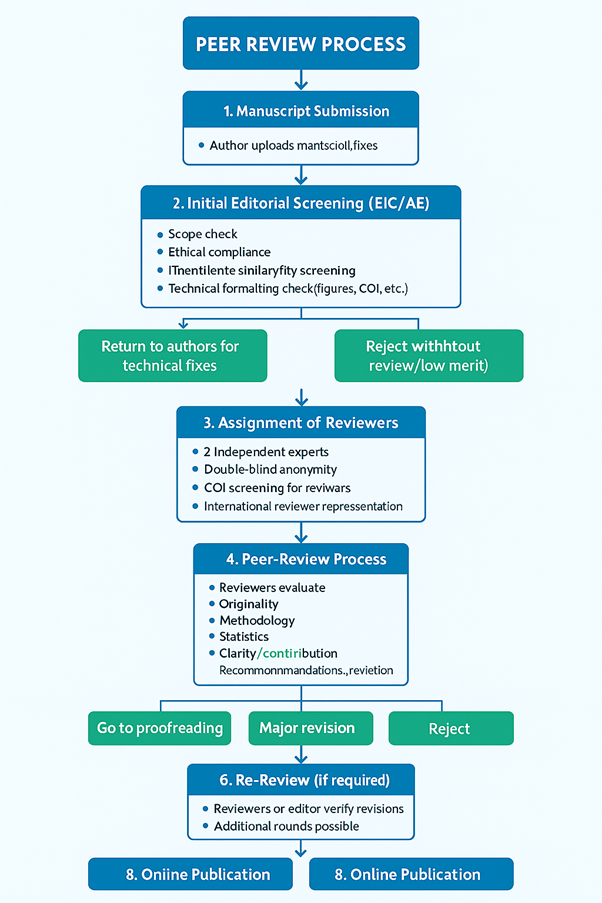
- Submission and Peer Review Process
12.1 Submission
Manuscripts are submitted via the JAHS online system (to be specified).
12.2 Initial Screening
- Scope check
- Plagiarism screening (iThenticate)
- Ethical compliance
- Technical formatting
12.3 Peer Review
- Double-blind
- Minimum two reviewers
- International reviewers preferred
12.4 Revision
Authors must upload:
- Tracked-changes manuscript
- Clean version
- Point-by-point rebuttal letter
12.5 Acceptance
- Final proofreading
- DOI assignment
- Online publication
- Publication Ethics
Authors must comply with:
- JAHS PEMS
- COPE guidelines
- ICMJE standards
- Plagiarism and AI policies
- Corrections and retraction policy
Misconduct may result in:
- Rejection
- Retraction
- Institutional notification
- Submission bans
- Copyright & Licensing
- Authors retain copyright
- Articles published under CC BY 4.0 licence
- No APCs or publication fees
- Contact
For questions regarding submissions, ethics, formatting, or policies:
Editor-in-Chief
Journal of Applied Health Sciences (JAHS)